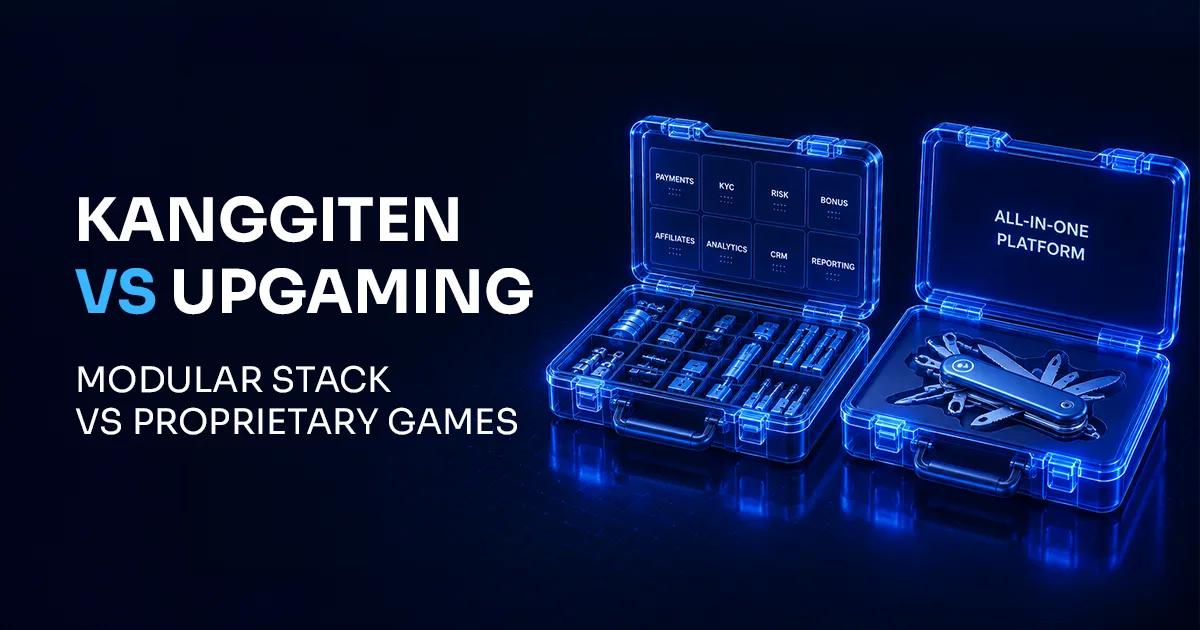
Kanggiten vs Upgaming: 2026 Turnkey Platform Comparison
Kanggiten brings a modular stack and a 20,000-game aggregation hub; Upgaming counters with a decade of B2B history and award-winning proprietary crash games. Here's how the two turnkey platforms compare for 2026.
- Kanggiten is the modular pick: white label, turnkey, casino platform, sportsbook, aggregator, affiliate module and CRM sold as composable blocks. Company-reported numbers: 50+ active brands, 3M+ players, a 20,000+ game hub from 150+ providers, and white-label launches in 2-4 weeks.
- Upgaming is the content-led pick: in business since 2014, an award-winning aggregator (company-reported 12,000+ games from 180+ providers), a sportsbook quoting 112,000+ live events with 120+ in-house bookmakers, and a proprietary crash-games studio, Upgames, whose Aero won Best Crash Game at SiGMA Europe 2023.
- Upgaming's 2026 story is Latin America: an Argentina office opened in 2025, a SiGMA South America awards shortlist, and company-reported GLI certification work for Brazil.
- Kanggiten's story is operator empathy: the platform is explicitly pitched at startups, affiliate networks, and studios expanding into operations, with heavy emphasis on post-launch support.
- Neither publishes pricing. Expect setup fee plus revenue share at both; the negotiation is about scope, minimums and who owns what when you leave.
Kanggiten vs Upgaming: Two Ways to Buy a Platform in 2026
One of these vendors is loud, the other is quiet, and that tells you most of what you need to know before the feature comparison even starts. Upgaming spent the first half of 2026 on the awards circuit: its sportsbook was shortlisted for Best Interactive Sportsbook Experience at the SiGMA South America Awards 2026, its Upgames studio picked up Global Gaming Awards shortlists, and the company worked the floor at SiGMA South America pitching Latin American operators. Kanggiten, meanwhile, barely does press at all. It's a vendor that reportedly converted more than a decade of running its own B2C brands into a modular B2B platform, and it lets the product pages do the talking.
Both sell turnkey. Both sell white label. Both bundle a casino aggregation hub, a sportsbook and the operational tooling around them. But they're built from opposite starting points: Kanggiten productized an operator's internal stack, while Upgaming grew outward from content and aggregation into a full enterprise platform. If you're choosing between them, that origin story shapes everything from the lobby to the contract.
Let's take them apart properly.
The two companies in 2026
Kanggiten's pitch starts with its history: over ten years operating consumer-facing iGaming brands before packaging that experience as a B2B platform. Even the name is a tell — it borrows from Kangiten, a Japanese deity associated with luck and prosperity, with an extra G added for emphasis. The product menu covers white label, turnkey, casino platform, sports betting platform, game aggregator, affiliate platform, analytics, and a CRM and marketing system, each sellable separately or as a bundle. The company reports 50+ active brands on the platform, 3M+ players and 7M+ monthly transactions, with 99.9% uptime. Treat all of those as company-reported figures; no vendor's dashboard numbers survive an independent audit intact.
Upgaming has been a B2B supplier since 2014, and its footprint has expanded steadily: offices in the Netherlands and Germany from 2020, Malta from 2022, Bulgaria from 2023, and Argentina from 2025, per the company's own timeline. Its ecosystem splits into four pillars — game aggregation, a sportsbook, an "enterprise platform" that deliberately blends white-label convenience with turnkey control, and Upgames, its in-house mini-games studio. External validation is stronger here than for most vendors this size: an Aggregator of the Year win at SiGMA Eurasia and SBC Awards nominations (both per the company), plus 2026 shortlists at SiGMA South America and, per the company, the Global Gaming Awards.
The shorthand: Kanggiten sells you an operator's toolkit, assembled from the inside out. Upgaming sells you a content and trading engine with a platform wrapped around it.
Casino content and aggregation
Both companies lead with a game aggregator, and the numbers look close until you read them carefully.
Kanggiten's hub quotes 20,000+ games from 150+ providers behind a single API, with the operational details that actually matter day to day: per-title metadata (RTP, volatility, demo availability, currency and country rules), regional blocklists and allowlists, and per-market lobbies. New providers can reportedly be activated within hours once the core integration is live. One consistency flag worth noting: Kanggiten's turnkey page quotes 10,000+ games while its aggregator page says 20,000+ — most likely the difference between a curated turnkey library and the full hub, but it's exactly the kind of discrepancy to pin down in an RFP.
Upgaming quotes 12,000+ casino and live casino games from 180+ providers, with the tier-one studios you'd expect — Pragmatic Play, Evolution, NetEnt, Play'n GO, Hacksaw, Nolimit City, Relax Gaming — plus its own exclusive crash titles folded into the same integration. Fewer total games than Kanggiten claims, more named provider relationships, and a differentiator neither the raw count nor the provider count captures: content Upgaming owns outright, which no rival aggregator can offer on identical terms.
For a lobby-size shootout, Kanggiten wins on paper. For content you can't get elsewhere, Upgaming does. Which matters more depends on your market — in crash-hungry regions, exclusives move retention more than the eleventh thousand slot title does.
Sportsbook depth
Neither company is sportsbook-first the way a dedicated sports supplier is, but both ship serious products.
Kanggiten's sportsbook quotes 62,000+ live matches and 40,000+ pre-match events per month, with esports as a genuine strength: 30+ disciplines with odds built on licensed data from Bayes Esports and GRID, plus 100+ eFootball and 40+ eBasketball markets on the virtuals side. Product features run modern — bet builder, player props, integrated video streams, a 2D Pitch Tracker, and "Fast Markets" that settle bets every 10-15 minutes within a match. Risk management combines AI-driven tooling with a company-reported team of 150+ trading professionals working around the clock.
Upgaming's sportsbook quotes bigger raw coverage — 112,000+ live events — and leans on human expertise: 120+ in-house bookmakers setting and managing odds, which is an unusually specific staffing claim for a vendor this size and suggests real in-house trading rather than a white-labeled feed. The SiGMA South America 2026 shortlist for Best Interactive Sportsbook Experience is third-party recognition that the front end holds up in a competitive market.
Both sets of numbers are company-reported and neither vendor publishes trading-liability terms publicly. Whichever way you lean, get trading hours, error policies and settlement SLAs in writing.
Crash games: aggregated vs owned
Here's the sharpest product difference between the two, and it matters more in 2026 than it would have five years ago — crash mechanics have been eating casino lobbies for years, especially in Latin America, Africa and parts of Asia.
Kanggiten treats crash games as a content category: its aggregator carries crash and fast-game titles from third-party studios alongside slots and live dealer content. That's the pragmatic approach — you get the market-proven hits without betting on any one studio.
Upgaming builds them. Upgames, its studio sub-brand, has shipped 20+ proprietary titles over six-plus years — Aero, Dino, Wingz, Lepinata, Pandastic and others — running on its own remote game server and distributed well beyond Upgaming's own platform through aggregation partners (the company reports availability via 220+ partners, with recent distribution deals including iGP and SoftGamings). Aero won Best Crash Game at SiGMA Europe 2023, and per the company Upgames is shortlisted at the Global Gaming Awards 2026 for both Crash Game of the Year and Breakthrough Company of the Year.
For an operator, the practical difference: on Upgaming, exclusive or early-access crash content can be part of the commercial conversation. On Kanggiten, crash is a checkbox the aggregator fills. Both are legitimate answers; only one is a differentiator.
Head-to-head: the comparison table
| Dimension | Kanggiten | Upgaming |
|---|---|---|
| Core identity | Modular platform born from B2C operations | Content-and-aggregation vendor grown into enterprise platform |
| Deployment models | White label (2-4 week launch, company-reported) or full turnkey under your own license | White label, turnkey, and API licensing; "enterprise platform" blends both models |
| Casino hub | 20,000+ games, 150+ providers, single API (company-reported) | 12,000+ games, 180+ providers, incl. exclusive in-house titles (company-reported) |
| Sportsbook | 62K+ live / 40K+ pre-match monthly, esports via Bayes and GRID data | 112K+ live events, 120+ in-house bookmakers (company-reported) |
| Proprietary content | None disclosed | Upgames: 20+ crash and mini-games, award-winning Aero |
| Regional signals | Regions not publicly disclosed; segment focus on startups, affiliates, studios | Offices in NL, Germany, Malta, Bulgaria, Argentina; active LatAm push |
| Affiliate and CRM | Built-in multi-level affiliate module, CRM and marketing system | Affiliate and payment systems bundled in enterprise platform |
| 2026 flagship news | Quiet; product-led marketing | SiGMA South America shortlist; Global Gaming Awards 2026 shortlists |
| Ideal buyer | First-time operator or affiliate going operator, wants modularity and hand-holding | Operator wanting exclusive content, trading depth, and a LatAm-aware partner |
Deployment models and who they're built for
Kanggiten is unusually explicit about who it's selling to: startups and entrepreneurs, affiliate networks moving into operations, and game studios or aggregators expanding their footprint. That focus shows up in the packaging. The white label is pitched as a speed play — infrastructure, licensing options, payments, content and back office ready in a reported 2-4 weeks against an industry norm of 4-8. The turnkey is the independence play: your license, your brand, your gamification math, with a 10,000+ game library, KYC/AML tooling and an affiliate module included. Post-launch, the company emphasizes a personal manager plus cross-team specialists — the kind of hand-holding first-time operators actually need and rarely ask about until week three.
Upgaming's enterprise platform makes a subtler argument: that the white-label-versus-turnkey binary is a false choice, and operators want white-label speed with turnkey-grade control over payments, affiliates and front-end customization. Its API-first posture also means you can take pieces — just the aggregation, just the sportsbook, just Upgames content — without the platform at all, a flexibility pattern we've covered in our look at API-first iGaming platforms. For technically capable teams, that's the more composable stack; for teams that want one throat to choke, Kanggiten's bundled model is simpler to buy.
On licensing, neither vendor's public claims should be taken at face value without diligence. Upgaming markets launches under Curacao or MGA frameworks and reports GLI certification work for Brazil; Kanggiten refers to "licensing options" without naming jurisdictions publicly. In both cases: ask for the specific legal structure, in writing, for your specific target market. Vendor marketing pages are not compliance opinions.
Pricing and commercial model
Neither publishes rates, so everything here is hedged — and should be pressure-tested in your own RFP.
Industry norms for full turnkey deals in this tier run setup fees from the tens of thousands upward plus a revenue share commonly in the 10-20% of NGR range, with monthly minimums that bite hardest in year one. White label typically trades a lower setup for a higher ongoing take and less independence — our white-label vs turnkey comparison walks through when each structure makes sense. Kanggiten's modular menu means the quote depends heavily on which blocks you take; Upgaming's component licensing cuts the same way, with the wrinkle that exclusive Upgames content can become a negotiating chip in a fuller platform deal.
Three questions that apply to both vendors:
- What are the monthly minimums, and do they step down if the platform misses agreed SLAs?
- Who owns player data, CRM logic and affiliate relationships if you migrate away?
- Does the revenue share tier down as GGR scales, in the contract rather than in a promise?
2026 momentum check
Upgaming's year so far reads like a company converting content wins into market entries: the SiGMA South America awards shortlist and conference push, Global Gaming Awards 2026 shortlists for Upgames, an Argentina office in its first full year, and continued distribution deals putting its crash titles into other vendors' aggregators. The through-line is Latin America, where crash content and localized sportsbook trading are exactly the right weapons.
Kanggiten's momentum is harder to read from the outside, which is itself a data point. The company publishes steady product and educational content, reports growing brand and player counts, and invests in its platform pages rather than press releases. For a buyer, that means diligence has to work harder: ask for reference operators, uptime reports and roadmap commitments, because the trade press won't do the verification for you. Quiet vendors are often excellent vendors — but the burden of proof shifts to the RFP.
Neither company shows distress signals. Both are shipping, both are hiring visibility in the market, and both will happily quote you — which is exactly when the fit question matters most.
Verdict: pick the origin story that matches yours
There's no absolute winner here, and anyone who tells you otherwise is selling one of them.
Pick Kanggiten if:
- You're a first-time operator, an affiliate network going operator-side, or a studio adding a B2C arm — the segments the platform is explicitly built for.
- You want a modular menu: start with white label for speed, graduate to turnkey under your own license without switching vendors.
- Lobby breadth matters in your market and a company-reported 20,000+ game hub from one API is the fastest route to it.
- You value heavy post-launch support — personal manager, cross-team specialists, training — over brand-name vendor prestige.
Pick Upgaming if:
- Exclusive content is part of your strategy: proprietary crash titles like Aero give you something competitors on generic aggregators can't match.
- Your growth map runs through Latin America, where Upgaming is visibly investing — Argentina office, Brazil certification work, SiGMA South America presence.
- You want sportsbook trading depth backed by a large in-house bookmaking team rather than a resold feed.
- Your tech team prefers API-level licensing — taking aggregation, sportsbook or content as components instead of a monolith.
If you're still deciding between deployment models before shortlisting vendors, start with the structural question — white label or turnkey — because the platform choice falls out of the ownership choice, not the other way around.
Alternatives to consider
Shortlists of one are how bad contracts happen. Three more names worth an RFP:
- SOFTSWISS — the volume leader in casino platform and aggregation, with deep crypto tooling and one of the largest game hubs in the industry. A heavier, more established option than either hero here.
- Slotegrator — turnkey and white-label casino plus the APIgrator content integration, with a long track record serving startup operators in emerging markets.
- NuxGame — fast-launch casino and sportsbook software with flexible API delivery, competing directly for the same startup-operator segment Kanggiten targets.