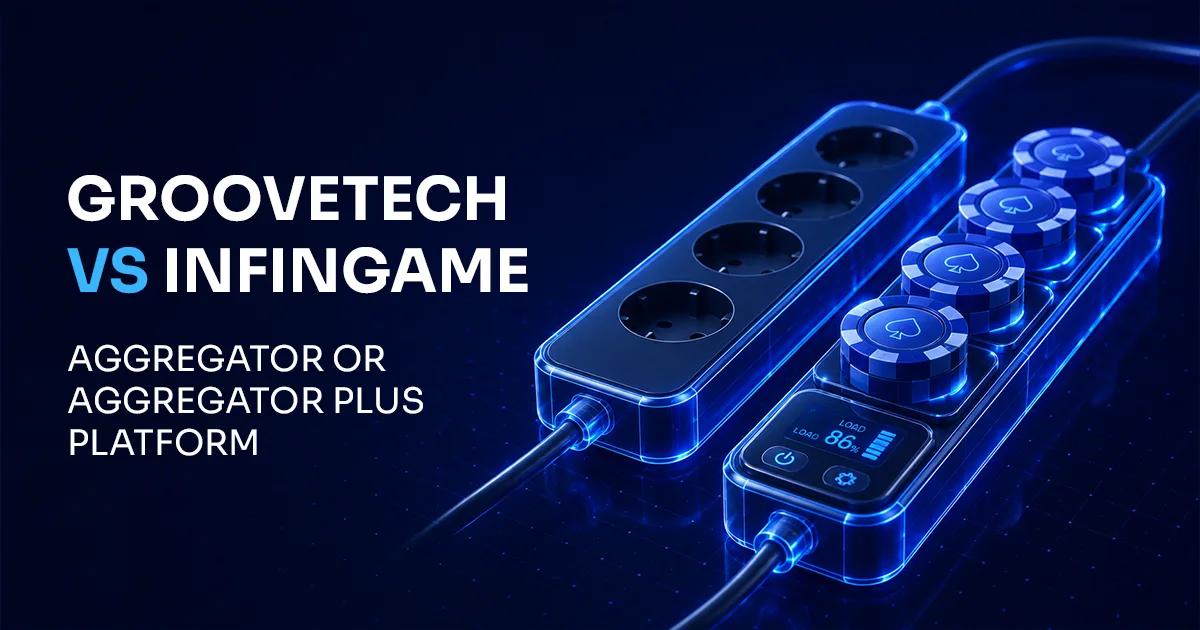
Groovetech vs Infingame: Aggregator, or Aggregator Plus Platform?
Two Curaçao-rooted casino aggregators with near-identical game counts and a genuinely different proposition: Groove wraps a turnkey platform around its content hub, Infingame stays a pure aggregation layer that plugs into what you already run.
- Groovetech (Groove Technologies) is the fuller stack: game aggregation plus a turnkey package covering back office, UI/UX, CRM, payments gateway, affiliate system and BI. Company-reported: 200+ providers, 15,000+ games, plus a dedicated sweepstakes aggregation product.
- Infingame is the specialist: a pure aggregation layer built to sit on top of whatever platform and wallet you already run, with promo tooling (tournaments, challenges) and an explicit "no replatform required" pitch. Company-reported: 16,000+ games, 150-200+ providers, 10B+ partner monthly transactions.
- Both publish inconsistent headline numbers across their own pages. That's normal in this market and it's exactly what an RFP is for.
- Both are Curaçao-centred, and the CGA's supplier regime takes full effect on 24 December 2026. Article 5.16(4) of the LOK bars licence holders from working with unregistered suppliers, which makes your aggregator's registration status your compliance problem too.
- Pick Groove if you want one vendor for content and operations. Pick Infingame if your platform is settled and content is the gap.
Groovetech vs Infingame: Same Shelf, Different Business
On paper these two look like the same product. Both are casino-only game aggregators -- no sportsbook on either side. Both quote game libraries in the 15,000-16,000 range from a single API. Both carry sweepstakes content. Both operate with Curaçao at the centre of their licensing story.
Read past the datasheets and they're selling different things. Groovetech wraps a full turnkey platform around its aggregation hub -- back office, CRM, payments gateway, affiliate system, BI. Infingame does the opposite, and says so plainly: it plugs into your existing platform and wallet rather than forcing a replatform.
That's not a feature difference. It's a decision about whether you're buying content or buying a business. And in 2026 there's a third factor neither company leads with, which may end up mattering more than either: Curaçao's supplier licensing deadline lands in December, and it puts an obligation on operators, not just suppliers.
The two companies
Groove Technologies presents itself as a platform-and-aggregator combination built by people with a decade-plus in iGaming. The corporate structure is explicit on its own site: Groove Technologies N.V., registered at Abraham de Veerstrat 9, Curaçao, operating under Curaçao gaming licence OGL/2024/309/0142. The product menu splits cleanly in two -- a game aggregation side (game portfolio, the Groove API, and a marketing API that handles free round bonuses and campaign assets) and a turnkey side (back office, UI/UX design, CRM, payments gateway, affiliate system, BI). There's also a separate sweepstakes aggregation product, which is a deliberate choice rather than a footnote.
Infingame reports a 2015 founding and positions itself as an aggregation specialist. The messaging is unusually disciplined for this market: one integration, hundreds of providers, and an explicit promise that it "plugs into current platforms and wallets, unlocking fresh revenue streams instead of forcing a replatform." Its product structure is content-shaped -- slots, crash, live casino, sweepstakes -- with promo tooling layered on top. The site runs an English and Spanish version, which tells you where the commercial attention is pointed.
One detail on Infingame's operator intake form is worth noting because it reveals a compliance posture most vendors don't advertise: it asks prospective sweepstakes and social operators whether they hold the legal opinions their model requires. That's a supplier screening its own customers, which is a good sign in a content category currently under heavy scrutiny -- see our analysis of the sweepstakes crackdown.
The numbers, and why they don't agree with themselves
Both companies quote different figures in different places. This isn't dishonesty; it's the normal gap between a curated portfolio, a full hub and a partner-facing count. But it's the first thing to pin down in a commercial conversation.
| Claim | Groovetech | Infingame |
|---|---|---|
| Games (headline) | 15,000+ | 16,000+ |
| Games (elsewhere on own materials) | 8,000+ at Groove Play | 15,000+ on the about page |
| Providers | 200+ on site; 120+ in some press coverage | 150+ on homepage; 200+ on about page |
| Sportsbook | No | No |
| Sweepstakes content | Yes, as a distinct product line | Yes, within the main portfolio |
| Crash content | Via aggregated studios | Named as a core category |
| Turnkey platform | Yes -- back office, CRM, payments, affiliate, BI | No -- integrates with your existing platform |
| Marketing tooling | Marketing API with free round bonuses and assets | Tournaments and challenges as native promo tools |
| Scale claim | Not publicly quantified | 10B+ partner monthly transactions |
| Licensing anchor | Curaçao N.V. under OGL/2024/309/0142 | Curaçao and Swedish market presence per catalog data |
Three questions that resolve most of the ambiguity above: how many titles are actually available in my target markets after geo and certification filtering; how many providers are live today versus contracted; and which of these numbers appears in the contract.
That last one matters. Game counts are marketing until they're a service level.
Content depth and provider mix
Groove's aggregation pitch centres on breadth and back-office control: per-title management, reporting, round history and campaign tooling through one integration, with a marketing API that handles free round bonuses across the portfolio. The FRB capability is a real differentiator for operators running frequent promotional cycles, because delivering bonus rounds consistently across dozens of studios is exactly the kind of plumbing that eats developer time when it isn't handled centrally.
Infingame's mix leans toward newer and mid-tier studios with an emphasis on fast onboarding, and its 2026 partnership run has been visible: it added Galaxsys to its portfolio, integrated Evoplay's full catalogue, and brought in InOut Games' crash and instant-win content. Named studios across its materials include 3 Oaks, Playson, Wazdan, Spribe, Spinomenal, NetGame and RubyPlay.
The pattern is a familiar one in aggregation: Groove sells the pipe and the control panel, Infingame sells the flow through it. Neither is inherently better. If your team already has strong back-office tooling, Groove's control layer duplicates what you own. If it doesn't, Infingame's content-first posture leaves you assembling the operational pieces elsewhere.
The structural question: replatform or plug in
This is the decision the comparison actually turns on.
Buying Groove's turnkey means one commercial relationship covering content, back office, CRM, payments and affiliates. Fewer vendors, fewer integration seams, a single support escalation path. The cost is concentration: your content supplier is also your platform, so a dispute in one area affects everything, and a future platform migration means moving your content relationships too.
Buying Infingame means adding content to a stack you keep. Your PAM, wallet, CRM and payment relationships stay where they are. The aggregator becomes a replaceable component -- which is exactly the API-first modularity argument, and it's why operators with a settled platform overwhelmingly prefer this shape. The cost is that you're responsible for the operational layer, and you need enough technical capability to integrate and monitor a content feed properly.
There's no universal answer, but there is a reliable tell. If you're asking "which aggregator should I use," you probably want Infingame's shape. If you're asking "who can run my casino," you're shopping for what Groove packages. Operators who haven't yet settled the underlying ownership question should start with our white label vs turnkey comparison before shortlisting either.
The Curaçao deadline both operators should be asking about
Here's the 2026 factor that doesn't appear in either company's sales deck, and it applies to any operator working with Curaçao-rooted suppliers.
The Curaçao Gaming Authority's supplier licensing and registration rules take full effect on 24 December 2026, closing the two-year transition period under the National Ordinance on Games of Chance (LOK). Domestic suppliers of essential goods or services to licensed operators need a CGA supplier licence. Foreign suppliers are exempt from licensing but still have to complete registration, with registration scheduled to open in October 2026.
The part operators keep missing: Article 5.16(4) of the LOK prohibits licence holders from working with unregistered suppliers. That means verifying your aggregator's status isn't a courtesy check -- it's a condition of your own licence. Groove's Curaçao incorporation puts it squarely in the domestic supplier category; any supplier established elsewhere falls under the foreign registration route. Either way, the question to put in writing before signing is simple: what is your CGA status, and can you evidence it before December?
Curaçao has been reshaping itself for a while now -- the regulator issued its first licences under the new regime after a long transition, and the direction is consistently toward higher bars. Our Curaçao licence guide covers the operator side; the supplier side is the newer obligation and the one currently catching people out.
Commercial model
Neither company publishes pricing, which is standard for aggregation. What's known about the shape:
- Aggregation is normally sold on revenue share of the GGR generated through the integrated content, sometimes with a platform or integration fee on top.
- Groove's turnkey packaging means the quote depends on how many modules you take. Content-only and full-stack deals are very different numbers.
- Infingame markets "predictable costs, transparent reporting and no hidden limits on providers or integrations," which reads as a shot at competitors who charge per additional provider. Get that written into the contract rather than the pitch.
- Studio-level economics vary. Premium studios command higher shares than mid-tier ones, and how the aggregator passes that through -- blended rate or per-provider -- changes your effective cost materially depending on your lobby mix.
Ask both for a worked example on your projected volumes and your actual game mix, not a rate card.
Head-to-head verdict
Pick Groovetech if:
- You want content and operations from one vendor, with back office, CRM, payments and affiliate tooling included rather than assembled.
- You're launching rather than scaling, and building an operational stack alongside a content deal is more work than you can absorb.
- Promotional mechanics across a wide portfolio matter, and a central marketing API for free round bonuses saves your team real integration work.
- A Curaçao-incorporated supplier with a published licence number simplifies your own due diligence file.
Pick Infingame if:
- Your platform is settled and content is the gap. Adding an aggregator shouldn't mean re-examining your PAM.
- You want the aggregator to stay a replaceable component rather than becoming the centre of your stack.
- Crash and fast-game content is central to your market -- it's a named core category rather than one shelf among many.
- Native tournament and challenge mechanics matter to your retention plan and you'd otherwise build them.
The honest summary: these companies compete for the same search terms and not really for the same deal. An operator with a platform is choosing between Infingame and other pure aggregators. An operator without one is choosing between Groove and other turnkey suppliers. The overlap is narrower than the category name suggests, and iGamingHub sees that pattern across most aggregator shortlists -- the real comparison set is defined by what you already own.
Alternatives worth an RFP
- SOFTSWISS -- the volume benchmark for casino aggregation, with deep crypto tooling and a platform business alongside it. Heavier and more established than either company here.
- Slotegrator -- APIgrator content integration plus turnkey and white label, with a long record serving startup operators in emerging markets.
- Hub88 -- content distribution built for technically capable operators who want clean APIs and minimal ceremony.
- Pariplay -- aggregation plus its Fusion tooling suite, aimed at operators who want engagement mechanics bundled with content.
For a wider view of the category, our game aggregator comparison sets out how the major players differ on integration model and content mix.